Synaptigen Review: A Probiotic Tablet Sold as Brain Support

Quick verdict
Synaptigen is, on its own label, an oral probiotic chewable: 100 mg of inulin, a 20 mg probiotic blend (3.5 billion CFU) and 20 mg of Streptococcus salivarius. None of these has good human evidence for memory or focus. The gut-brain connection is a real research field, but it is early and does not support these strains for brain benefits. It is easy to take and has a 60-day guarantee, but we would not buy it for memory.
What Is Synaptigen?
Synaptigen is a dietary supplement sold online as support for “healthy brain function”, “clear mind” and “sustained mental agility”. It comes in bottles of 30 tablets, and the label says to take one tablet once or twice a day, letting it dissolve in the mouth or chewing it slowly. It is sold through BuyGoods, and the label lists a distributor in Tallmadge, Ohio.
What surprised us is the formula. Instead of the usual brain ingredients (bacopa, ginkgo, caffeine, omega-3s), the Supplement Facts panel shows inulin fiber and probiotic bacteria: Lactobacillus paracasei, Lactobacillus reuteri, Bifidobacterium lactis BL-04 and Streptococcus salivarius. That is a combination usually found in chewable products for the mouth and gums. In fact, the panel lists the same ingredients and amounts as ProDentim, an oral probiotic chewable we reviewed earlier.
Pros and Cons
👍 What we like
- The Supplement Facts panel is short and names every strain.
- Total probiotic count (3.5 billion CFU) is stated, which many products skip.
- No caffeine or stimulants, so it will not affect sleep.
- Chewable tablet, easy to take.
- 60-day money-back guarantee through BuyGoods.
👎 What to keep in mind
- There is no good human evidence that these strains improve memory, focus or brain health.
- The individual strain amounts are hidden in a 20 mg “proprietary blend”.
- 100 mg of inulin is a very small amount of fiber (studies on gut effects usually use grams).
- The brain-focused marketing does not match what is on the label.
- $1.63 to $2.63 per day at one tablet a day, double that at two.
Synaptigen Label and Doses
This is the full Supplement Facts panel from the official website, with our comparison against the doses typically used in research.
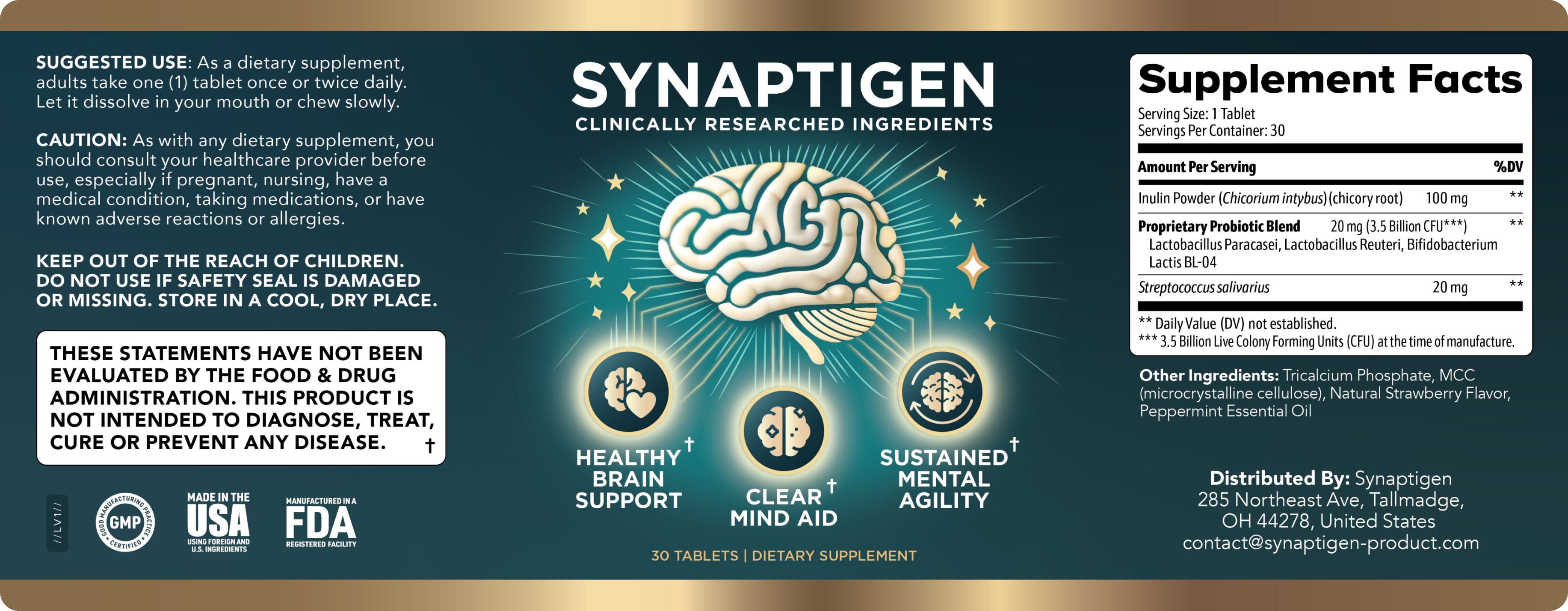
| Ingredient | Per tablet | What studies typically use | Our take |
|---|---|---|---|
| Inulin (chicory root) | 100 mg | Prebiotic studies usually use about 3–10 g a day | Far below |
| Probiotic blend: L. paracasei, L. reuteri, B. lactis BL-04 | 20 mg (3.5 billion CFU) | Probiotic studies use roughly 1–10 billion CFU, but for gut or oral health, not memory | Not for brain |
| Streptococcus salivarius | 20 mg (CFU not stated) | Studied mainly for mouth and throat health | Not for brain |
Other ingredients: tricalcium phosphate, microcrystalline cellulose, natural strawberry flavor, peppermint essential oil. Daily values are not established for these ingredients. Study ranges are general and refer to each ingredient on its own, not to Synaptigen.
Ingredient by Ingredient
Tap each ingredient to see what it does and what the research says at the dose in Synaptigen.
🌾 Inulin from chicory root — 100 mg
Inulin is a soluble fiber that feeds beneficial gut bacteria. Studies on digestion and gut bacteria usually use 3 to 10 grams a day, so 100 mg is about 1 to 3% of that. It is mainly here as a carrier and food for the probiotics.
🦠 Lactobacillus paracasei, L. reuteri and B. lactis BL-04 — 20 mg blend (3.5 billion CFU)
These are common, well-tolerated probiotic species studied for digestion, immunity and, in the case of L. reuteri and L. paracasei, the mouth and gums. A few small studies have looked at certain probiotic mixes and mood or stress, with mixed results and different strains. We found no good human study showing these strains improve memory or focus.
🦷 Streptococcus salivarius — 20 mg
S. salivarius is a bacterium that naturally lives in the mouth. Specific strains (such as K12 and M18) have been studied for bad breath, throat and dental health. The label does not say which strain is used, and there is no evidence it affects the brain.
🌿 Peppermint oil and strawberry flavor
These are flavorings that make the tablet pleasant to chew. They do not add a brain benefit.
What the Sales Page Says vs. What We Found
📣 The claim
The sales page presents Synaptigen as a breakthrough for brain health, with the label promising “healthy brain support”, a “clear mind” and “sustained mental agility”.
🔎 What we found
The ingredients are a probiotic and fiber blend with no meaningful human evidence for memory, focus or cognitive decline. Research on the gut-brain axis is real but early, and it does not show that these strains, at these amounts, improve thinking. No study has tested Synaptigen itself.
Our view: if memory or focus is your goal, Synaptigen is not the product we would choose. Sleep, exercise, treating hearing loss and checking B12 and thyroid levels have stronger evidence. Noticeable memory changes should be discussed with a doctor.
Is Synaptigen a Fit for You?
Answer three quick questions:
Safety and Possible Side Effects
Talk to a doctor before taking Synaptigen if you:
- Have a weakened immune system, are on chemotherapy, or have a central venous catheter (live bacteria can rarely cause infections).
- Are pregnant or nursing.
- Have a serious illness or are recovering from surgery.
- Take medication and want to check for interactions with your pharmacist.
Probiotics are generally well tolerated. Mild bloating or gas in the first days is the most common side effect. Take it as directed on the label.
Synaptigen Price and Guarantee
 6 Bottles · 180 days
≈ $1.63 per day
 3 Bottles · 90 days
Prices from the official order page on October 20, 2026, at one tablet a day. If you take two tablets a day, as the label allows, each bottle lasts 15 days and the daily cost doubles. International orders pay shipping fees. Prices can change, so confirm the final total before paying.
📊 Full breakdown of every package, cost per day and refund steps: Synaptigen price guide →
Synaptigen FAQ
What is Synaptigen?
Synaptigen is a chewable tablet marketed for brain health. According to its label, each tablet contains 100 mg of inulin, a 20 mg probiotic blend with 3.5 billion CFU of Lactobacillus paracasei, Lactobacillus reuteri and Bifidobacterium lactis BL-04, and 20 mg of Streptococcus salivarius.
Does Synaptigen work for memory?
We found no good human evidence that the probiotic strains and inulin in Synaptigen improve memory, focus or brain health. No study has tested Synaptigen itself.
How do you take Synaptigen?
The label says to take one tablet once or twice a day and let it dissolve in the mouth or chew it slowly.
Is Synaptigen safe?
Probiotics are generally well tolerated, with mild bloating or gas being the most common side effects. People with weakened immunity, serious illness, or who are pregnant or nursing should talk to a doctor first.
How much does Synaptigen cost?
On the official order page on October 20, 2026: 2 bottles for $158 ($79 each), 3 bottles for $207 ($69 each) or 6 bottles for $294 ($49 each, free US shipping and bonuses).
Does Synaptigen have a money-back guarantee?
Yes. The official page offers a 60-day money-back guarantee. Orders are one-time payments processed by BuyGoods.
Final Verdict
Synaptigen has an honest-looking, readable label, but what it contains is a probiotic and fiber chewable, not a brain formula. We found no good evidence that these ingredients improve memory, focus or mental sharpness, so the main promise on the bottle is not backed by research.
If you want a probiotic chewable, it may be fine, with a 60-day guarantee to fall back on. If your goal is memory or focus, we would put the money toward sleep, exercise and a check-up with your doctor first.
Check Synaptigen on the Official Site
See current prices and packages, with the 60-day money-back guarantee.
Affiliate disclosure: If you buy through our links we may earn a commission, at no extra cost to you. This does not change our verdict. Learn more.