MemoGenesis Review: Ingredients, Doses and Our Honest Verdict
Quick verdict
MemoGenesis is a mild caffeine-based focus capsule with B vitamins. We like that the label shows every dose. But the memory herbs (bacopa, rhodiola, huperzine A) are included at a small fraction of the amounts used in research, so we would not buy it expecting long-term memory benefits.
What Is MemoGenesis?
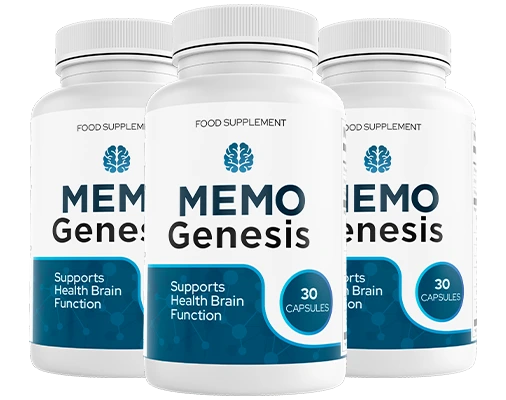
MemoGenesis is a dietary supplement sold online as support for “healthy brain function”. It comes in bottles of 30 capsules, and the label directs adults to take one capsule a day with food. It is sold through Digistore24, and the label lists a distributor in Aurora, Colorado.
The formula mixes three groups of ingredients: stimulants (caffeine, theacrine, theobromine), B vitamins (B1, B6, B12) and herbs and nutrients often linked to memory (bacopa, rhodiola, huperzine A, L-tyrosine). How much of each one you get is what decides whether it can do anything, so that is where we focused.
Pros and Cons
👍 What we like
- Every ingredient and dose is listed. No hidden “proprietary blend”.
- 50 mg of caffeine is a sensible, moderate dose for a mild focus lift.
- B vitamins cover daily needs in one capsule.
- One capsule a day, simple to use.
- 60-day money-back guarantee on every package.
👎 What to keep in mind
- Bacopa, rhodiola, L-tyrosine and huperzine A are far below the doses used in studies.
- Expensive for what is mostly caffeine and B vitamins ($1.63–$2.63 per day).
- Not a good choice if caffeine makes you jittery or affects your sleep.
- No published study on the MemoGenesis formula itself.
- Huperzine A needs a doctor’s OK if you take medication.
MemoGenesis Label and Doses
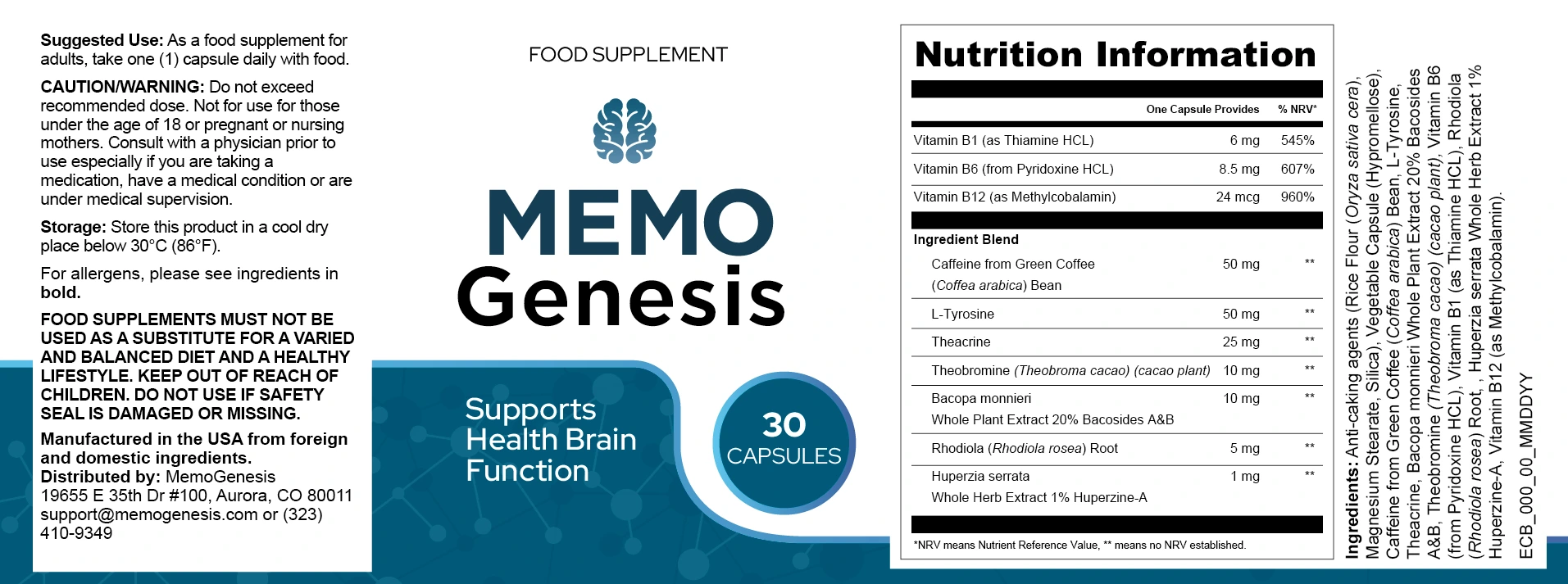
This is the full “Nutrition Information” panel from the official website, with our comparison against the doses typically used in research.
| Ingredient | Per capsule | What studies typically use | Our take |
|---|---|---|---|
| Caffeine (green coffee bean) | 50 mg | Around 40–100 mg improves alertness in many studies | Meaningful dose |
| Vitamin B1 (thiamine) | 6 mg (545% NRV) | Helps if your intake is low | Covers daily needs |
| Vitamin B6 | 8.5 mg (607% NRV) | Helps if your intake is low | Covers daily needs |
| Vitamin B12 (methylcobalamin) | 24 mcg (960% NRV) | Helps if your intake is low | Covers daily needs |
| L-Tyrosine | 50 mg | Studies on stress and focus usually use grams | Far below |
| Theacrine | 25 mg | Studies usually start around 50 mg | Below |
| Theobromine (cacao) | 10 mg | Studies usually use a few hundred mg | Far below |
| Bacopa monnieri (20% bacosides) | 10 mg | Memory studies usually use about 300 mg of extract daily for 8–12 weeks | Far below |
| Rhodiola rosea root | 5 mg | Studies usually use about 200–600 mg | Far below |
| Huperzia serrata (1% huperzine A) | 1 mg (≈10 mcg huperzine A) | Studies usually use a few hundred mcg of huperzine A | Far below |
Other ingredients: rice flour, magnesium stearate, silica and a vegetable capsule (hypromellose). “Typical study doses” are general ranges from published research on each ingredient on its own, not on MemoGenesis.
Ingredient by Ingredient
Tap each ingredient to see what it does and what the research says at the dose in MemoGenesis.
☕ Caffeine from green coffee bean — 50 mg
Caffeine is one of the best-studied ingredients for alertness, reaction time and attention. 50 mg is roughly half a cup of brewed coffee, enough for a mild lift in many people. It is likely the ingredient you will actually feel in MemoGenesis. Effects wear off after a few hours, and it can affect sleep if taken late in the day.
💊 Vitamins B1, B6 and B12
These B vitamins are involved in normal energy metabolism and nervous system function. Doses here are well above daily reference values. If your diet is low in them (for example, some older adults or people eating little animal food may be low in B12), topping up can help with tiredness linked to a deficiency. If you are not low, extra amounts are unlikely to sharpen memory.
🧪 L-Tyrosine — 50 mg
Tyrosine is an amino acid the body uses to make dopamine and noradrenaline. Research on mental performance under stress has typically used doses in the gram range. At 50 mg, MemoGenesis provides a very small fraction of that.
⚡ Theacrine — 25 mg and Theobromine — 10 mg
Both are relatives of caffeine. Theacrine has been studied for energy and mood, usually starting around 50 mg. Theobromine is the main stimulant in cocoa, and studies tend to use a few hundred milligrams. Here they mainly add to the overall stimulant profile.
🌿 Bacopa monnieri — 10 mg
Bacopa is a traditional herb with some of the better evidence among natural memory ingredients, but that evidence comes from roughly 300 mg of extract a day taken for 8 to 12 weeks. 10 mg is about 3% of that, so we would not count on a memory effect from bacopa in this formula.
🌸 Rhodiola rosea — 5 mg
Rhodiola is an adaptogen studied for mental fatigue, with mixed results at doses of about 200 to 600 mg. 5 mg is a token amount.
🍃 Huperzia serrata (huperzine A) — 1 mg
Huperzine A slows the breakdown of acetylcholine, a messenger involved in memory. Studies have generally used a few hundred micrograms a day; this capsule provides about 10 micrograms. It still matters for safety: huperzine A can interact with some medicines, so check with your doctor if you take any.
Is MemoGenesis a Fit for You?
Answer three quick questions:
Safety and Possible Side Effects
Who should avoid it or talk to a doctor first:
- Anyone under 18, and anyone pregnant or breastfeeding (the label says it is not for them).
- People sensitive to caffeine, or with anxiety, sleep problems, high blood pressure or heart rhythm problems.
- Anyone taking medication, especially for dementia, glaucoma, heart rhythm or bladder control, because huperzine A affects acetylcholine.
- Anyone scheduled for surgery.
Possible side effects mostly come from the stimulants: jitteriness, a faster heartbeat, stomach upset or trouble sleeping, especially if you also drink coffee, tea or energy drinks. Do not take more than one capsule a day, and avoid taking it late in the afternoon.
MemoGenesis Price and Guarantee
 2 Bottles · 60 days
 6 Bottles · 180 days
≈ $1.63 per day
Prices from the official order page on October 9, 2026. All packages include the 60-day money-back guarantee. Prices can change, so confirm the final total at checkout. Our tip: if you are trying it for the first time, a smaller package lets you check how you react to the caffeine before committing to six bottles.
MemoGenesis FAQ
What is MemoGenesis?
MemoGenesis is a once-a-day capsule sold online as a brain-support supplement. Each capsule combines 50 mg of caffeine from green coffee bean with B vitamins (B1, B6, B12), L-tyrosine, theacrine, theobromine and small amounts of bacopa, rhodiola and huperzine A.
Does MemoGenesis work?
No supplement study has tested MemoGenesis itself. Its most active ingredient at the listed dose is caffeine, which is well known to improve alertness for a few hours. The B vitamins can help if you are low in them. Bacopa, rhodiola, L-tyrosine and huperzine A appear at doses far below those used in most studies, so we would not expect noticeable effects from them.
How much caffeine is in MemoGenesis?
50 mg per capsule from green coffee bean, roughly half of a regular cup of coffee, plus 25 mg of theacrine and 10 mg of theobromine, which are related compounds. Count it toward your daily caffeine intake.
Is MemoGenesis safe?
The label lists common ingredients, but it is not for people under 18, or during pregnancy or breastfeeding. Because it contains caffeine and huperzine A, talk to your doctor first if you take any medication (especially for dementia, glaucoma, heart rhythm, anxiety or sleep), have a heart condition or are sensitive to caffeine.
How much does MemoGenesis cost?
On the official order page: 2 bottles for $158 ($79 each, plus $9.99 US shipping), 3 bottles for $207 ($69 each, free US shipping) or 6 bottles for $294 ($49 each, free US shipping). Each bottle has 30 capsules, so that is about $1.63 to $2.63 per day. Prices can change, so confirm at checkout.
Does MemoGenesis have a money-back guarantee?
Yes. The official order page offers a 60-day satisfaction guarantee on all packages. Orders are processed by Digistore24, so keep your order confirmation email to request a refund.
Final Verdict
MemoGenesis gets credit for something many brain supplements avoid: a clear label with every dose. Read that label carefully, though, and the picture is simple. The ingredients present at meaningful amounts are caffeine and B vitamins. The ingredients most linked to memory research are there in token amounts.
If you want a convenient, moderate caffeine capsule with B vitamins and you are fine with the price, it is a reasonable option backed by a 60-day refund window. If your goal is long-term memory support, we would look for a formula with research-level doses, or talk to your doctor about what may help in your situation.
Check MemoGenesis on the Official Site
See current prices and packages, with the 60-day money-back guarantee.
Affiliate disclosure: If you buy through our links we may earn a commission, at no extra cost to you. This does not change our verdict. Learn more.